Plato and Aristotle on Poets and Poetry
Plato, Aristotle, and the Fear of Poetry: An Epistemological Debate
Plato’s hostility toward poetry is one of the most provocative moments in the history of literary theory. In The Republic, he famously banishes poets from his ideal state, arguing that poetry is dangerously deceptive and epistemologically unsound. This exclusion is grounded in Plato’s metaphysical understanding of reality, where truth exists not in the material world but in the eternal and immutable realm of Forms.
According to Plato, the visible world is merely a transient shadow of true reality. A carpenter, when crafting an object such as a bed, imitates the ideal Form of “bedness.” The poet, in turn, imitates the carpenter’s imitation. Poetry thus becomes thrice removed from reality, making it an unreliable source of knowledge. Since Plato privileges reason and intellect as the only legitimate means of accessing truth, poetry—rooted in emotion, imagination, and sensory appeal—appears fundamentally misleading.
This suspicion intensifies in Ion, where Plato presents poets as divinely inspired rather than rationally grounded. Poets speak not through knowledge but through possession by the Muses. While this inspiration renders them fascinating, it also makes them intellectually unstable. For Plato, such emotional excess poses a threat to the moral education of future philosopher-kings, who must be trained in discipline, logic, and rational judgment. Poetry, therefore, must be excluded from the educational framework of the ideal state.
Aristotle, Plato’s own pupil, offers a strikingly different evaluation of poetry in Poetics. While he shares Plato’s belief in absolute truth on an ontological level, he diverges sharply on epistemological grounds. Aristotle does not view imitation as a degradation of truth. On the contrary, imitation is a natural human activity through which learning occurs. Poetry, for Aristotle, does not merely copy appearances but represents universal truths through particular actions and events.
Most importantly, Aristotle attributes a clear purpose to poetic imitation. Tragedy, he argues, arouses pity and fear in the audience, leading to catharsis—an emotional and psychological purification. Through this process, poetry performs a vital social and ethical function. Rather than corrupting the soul, tragedy educates emotions and fosters moral reflection.
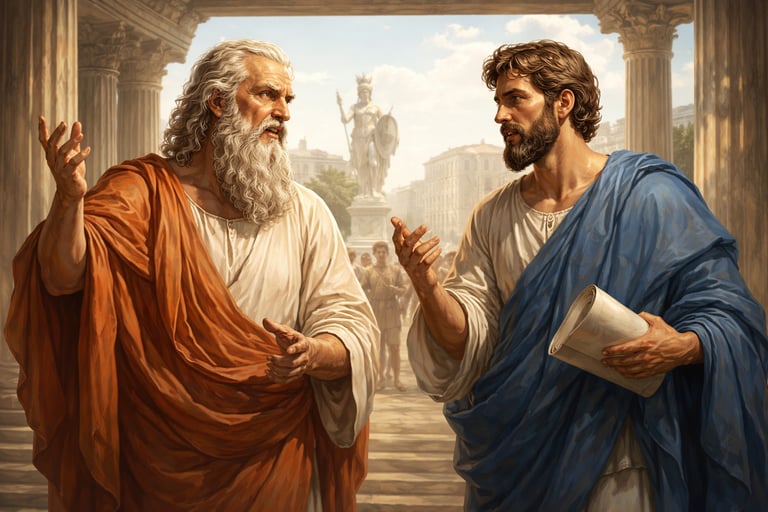
The disagreement between Plato and Aristotle, therefore, is not about the existence of truth but about how truth can be approached. Plato seeks direct access to truth through philosophy, dismissing emotional and imaginative modes of knowing. Aristotle, however, recognizes the value of proximity to truth, where experiential and representational forms of knowledge complement rational inquiry.
This philosophical tension also explains Plato’s deeper anxiety about poets. Philosophers represent logic, order, and rationality, whereas poets operate through paradox, ambiguity, and metaphor. As Cleanth Brooks later observes, paradox is not a flaw but the very language of poetry. Plato’s rejection of poetry thus stems from its resistance to logical containment.
Friedrich Nietzsche illuminates this conflict in The Birth of Tragedy. He argues that Greek tragedy embodied a dynamic balance between the Apollonian principle of order and the Dionysian principle of chaos and ecstasy. With the rise of Socratic rationalism, philosophy displaced tragedy, privileging reason while suppressing emotional and aesthetic knowledge. Plato, from this perspective, becomes a philosophical agent of tragedy’s demise.
In conclusion, Plato’s fear of poetry reflects a philosophical anxiety about the limits of reason. Aristotle’s defense, on the other hand, affirms poetry as a legitimate mode of knowing—one that engages emotion, ethics, and imagination. Literary studies, as a discipline, are born from this enduring debate between rational certainty and imaginative truth.
Email:
letsfindtruth12.gmail.com
© 2025. All rights reserved.